
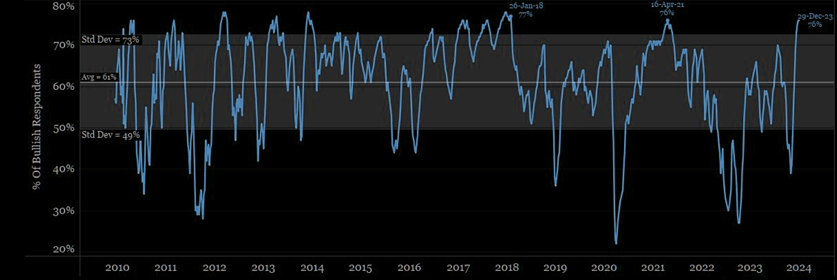
As market participants, it’s essential to keep a finger on the pulse of the general market sentiment — it can often act as a harbinger for future movements. Consensus Inc., a reputed firm known for its meticulous surveys of futures market newsletters and brokerage reports, provides such a pulse. Their latest findings suggest a crescendo of optimism not seen in years, marking a significant shift in market dynamics.
Through their weekly surveys, Consensus Inc. has aggregated the percentage of market commentaries that lean bullish. The data paints an intriguing picture: the stock index series is now at its most bullish point since 2018. But what does this mean for investors and traders?
Bullish sentiment is a measure of the extent to which market experts believe prices will rise. An increase in this percentage can indicate several things. It may reflect a collective vote of confidence in economic indicators, corporate earnings, or perhaps a reaction to fiscal and monetary policies that favor market growth.
A closer look at the provided graph reveals a fluctuating journey with peaks and troughs corresponding to various market events. The darkened band highlights the standard deviation, giving a sense of the typical range of bullish sentiment. Currently, the line soars, piercing through the upper echelon of this band, indicating an unusual level of optimism.
However, seasoned market watchers know that extreme levels of bullish sentiment can sometimes serve as a contrarian indicator. When most are leaning one way, it can pay to at least consider the opposite direction. This doesn’t mean a market downturn is imminent, but it certainly suggests that one should be mindful of the potential for overextended positions and the possibility of a correction.
Investors might respond to this in several ways. A common approach is to rebalance portfolios, ensuring that one’s investment allocations are not overly aggressive in the face of heightened optimism. This is also a time for investors to re-evaluate their risk tolerance and investment horizon.
Reflecting on the past, we see that similar spikes in bullish sentiment have sometimes preceded significant market movements. For instance, the spike in 2018 came before a period of volatility. This doesn’t imply a direct causation, but it underlines the importance of context. What macroeconomic conditions or market events are driving this bullishness? Are there underlying risks that are being overshadowed by the prevailing optimism?
For traders, this could be a time to look for opportunities where the market may have overreacted to the upside. For long-term investors, it might be a signal to stick to their investment strategies and not get swayed by the herd.
As with any indicator, the bullish sentiment reported by Consensus Inc. should not be used in isolation. It’s one of the many tools in an investor’s toolbox. Pairing this with a robust analysis of market fundamentals, technicals, and other sentiment indicators will provide a comprehensive view.
The rise in bullish sentiment to levels unseen since 2018 certainly makes for an interesting market climate. Whether this is a signal to forge ahead with confidence or a cautionary flag to prepare for turbulence remains to be seen. What’s clear is that in the complex tapestry of market indicators, sentiment plays a crucial role. As always, a balanced approach, combining sentiment with other market analysis tools, will likely serve investors best in navigating these bullish tides.


 IBAFIN
Leave a comment