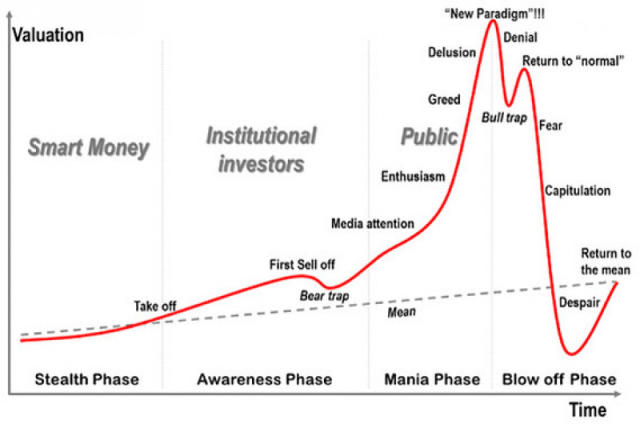
The ebb and flow of markets can often feel like a psychological thriller, complete with twists, turns, and an array of emotions. The image we’re discussing today breaks down this experience into a sequence of emotional stages that investors might go through during a typical market cycle.
At the beginning, we have the ‘Stealth Phase,’ where the ‘Smart Money’—usually informed investors like hedge funds and high-net-worth individuals—begins to accumulate the asset, recognizing its potential before the broader market does. Valuations are low, and attention is minimal, setting the stage for potential growth.
Next, the ‘Awareness Phase’ kicks in as institutional investors start to take notice. The media may begin to cover the asset, and early majority investors join in. This leads to a steady increase in price, and the market experiences its ‘First Sell Off’ and ‘Bear Trap.’ These are minor pullbacks that shake out some of the earlier speculative investors but are generally followed by a recovery.
As the cycle progresses, we enter the ‘Mania Phase.’ Here, the general public gets involved, fueled by stories of people earning high returns, often leading to a fear of missing out (FOMO). The price skyrockets as ‘Enthusiasm,’ ‘Greed,’ and ‘Delusion’ set in, culminating in the peak, often labeled as the ‘New Paradigm,’ where the prevailing belief is that the soaring prices can only go higher.
However, what goes up must come down. The ‘Blow Off Phase’ is marked by a shift in sentiment. Once a critical mass of investors decides to take profits or the market runs out of new money, the trend reverses. This leads to the ‘Bull Trap,’ where a brief rally tricks some into thinking the uptrend is resuming, only to be followed by a more severe downturn.
‘Denial’ sets in as investors believe the drop is just temporary. But as the decline continues, ‘Return to “normal”‘ gives way to ‘Fear,’ then ‘Capitulation’—a mass sell-off. Eventually, the market bottoms out at ‘Despair,’ where the asset is undervalued, and the cycle is poised to start all over again with the ‘Return to the Mean.’
This model serves as a reminder of the powerful role that collective emotion and psychology play in financial markets. By understanding these phases, investors can attempt to make more rational decisions, rather than being swayed by the mood swings of the market. However, it’s crucial to note that while this cycle can be a useful tool for understanding market dynamics, predicting the timing and magnitude of these phases is notoriously challenging. Like all models, it’s an oversimplification and should be one of many tools investors use when considering where we are in the cycle and making investment decisions.


 IBAFIN
Leave a comment