Investing in the financial markets is often akin to riding a roller coaster, complete with its own set of highs and lows, twists and turns. One theory that attempts to conceptualize this journey is the Market Cycle Theory, which outlines the emotional and psychological progression of investors through different market phases.
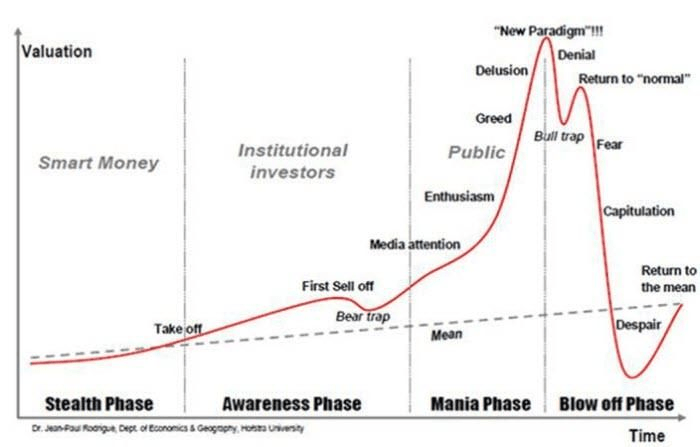
A graphical representation of this theory, as depicted by Dr. Jean-Paul Rodrigue from Hofstra University, divides the market cycle into four main phases: the Stealth Phase, the Awareness Phase, the Mania Phase, and the Blow-off Phase. Each phase is characterized by distinct investor behavior and market sentiment.
1. The Stealth Phase: The Beginning of the Journey
During the Stealth Phase, the ‘smart money’, or the most informed investors, begin to notice the undervaluation in the market. This phase is marked by low activity and interest among the general public. These investors quietly accumulate stocks, anticipating future gains.
2. The Awareness Phase: Gaining Momentum
As the market starts to pick up, institutional investors join in, recognizing the potential that the smart money has seen. The first sell-off occurs here, often referred to as the ‘bear trap’, where the market dips briefly, shaking out weak investors before the upward trend resumes. Media attention starts to grow, further fueling the market.
3. The Mania Phase: Peak Excitement
The Mania Phase is where the public jumps aboard, driven by a mix of greed and the fear of missing out. Prices skyrocket, and talk of a ‘new paradigm’ begins to circulate, suggesting that old valuation models are obsolete. During this phase, investors throw caution to the wind, often ignoring the risks and the fundamental mismatch between valuations and the underlying assets. It’s suggested that currently, in 2024, we might be in the ‘Enthusiasm’ part of this phase, with investors trading heavily influenced by events such as elections, without much concern for balancing their portfolios or hedging risks.
4. The Blow-off Phase: The Descent into Despair
Eventually, reality sets in, and the market corrects—often drastically. The ‘bull trap’ occurs when there’s a false signal that the bull market will resume, leading to more investment just before the fall. As the market plunges, investors go through denial, fear, capitulation, and ultimately despair. This phase concludes with the market stabilizing around its mean value, sometimes referred to as ‘the return to the mean’.
The theory posits that understanding where we are in this cycle can be crucial for investors. For instance, the current enthusiasm suggests a period where risk appetite is high and correlations between asset classes may be less pronounced. Investors tend to trade more aggressively, often influenced by rumors and short-term events, such as elections, rather than long-term fundamentals.
In essence, navigating the market requires not just an understanding of financial fundamentals but also an acute sense of market sentiment and psychological undercurrents. While the Market Cycle Theory offers a framework, it’s important to remember that no theory can predict market movements with complete accuracy. Diversification and risk management remain as important as ever, especially as we potentially approach the upper echelons of the mania phase.
As investors, it’s vital to remain vigilant, keep an eye on market indicators, and not get carried away by the euphoria or despair that comes with the territory. In the end, the markets are a test of one’s patience, discipline, and resilience.


 IBAFIN
Leave a comment