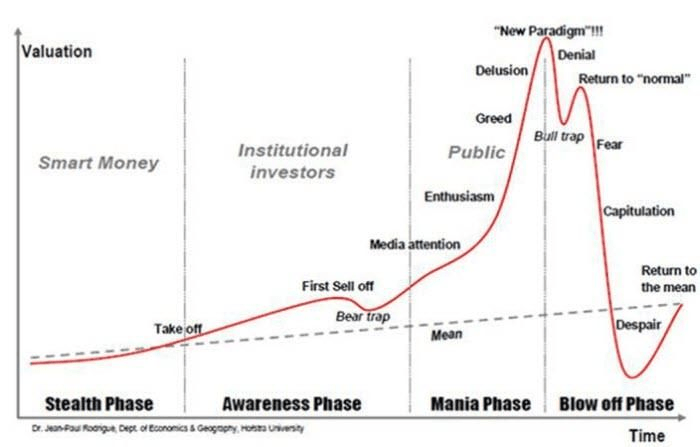
In the financial world, understanding market sentiment and its phases is crucial for investors seeking to navigate the ever-fluctuating landscape. Currently, the general atmosphere can be best described as one of “Enthusiasm.” This is a stage where the general public’s interest in the market is piqued, often following a period where early adopters and institutional investors have already established their positions.
The term “Enthusiasm” may seem like a simplified descriptor, but it serves as a useful shorthand for a specific phase in the market cycle where optimism begins to take a stronger hold, and more participants are drawn in by the potential of further gains. This is typically a period where media attention starts to amplify the positive sentiment, and the stories of success and potential wealth begin to circulate more widely.
If we were to take a short-term view, for example, analyzing the movements of the E-Mini S&P 500 Futures (ES), the recent sell-off could be interpreted as “the first sell-off” – a correction that follows what some might consider the “take off” phase. The “take off” is typically characterized by a significant break away from average prices, signaling the start of a more robust upward trend. In this context, the move towards the 5000 level in ES could be seen as such a moment.
However, it’s important to remember that these interpretations are highly dependent on one’s perspective. Market phases are not always clearly delineated and can overlap or be subject to various external factors, such as economic data releases, geopolitical events, or shifts in monetary policy. The enthusiasm phase, while often marked by a surge in investor interest, can also lead to overvaluation if not tempered by a clear understanding of the underlying value and potential risks.
As with any investment strategy, caution and due diligence are advised. Investors should remain vigilant for signs of excess, where valuation surpasses fundamentals, and be prepared for the possibility of volatility as the market cycle continues to evolve. It’s also worth noting that these phases are part of a larger cycle that includes periods of peak sentiment, followed by a potential downturn and a return to the mean, which can offer opportunities for those who have the foresight to anticipate these changes.
In conclusion, whether one views the market as being in a state of enthusiasm, or on the cusp of another phase, depends on a myriad of factors. What remains constant is the need for a disciplined approach to investing, one that accounts for the cyclical nature of markets and the psychological underpinnings that drive investor behaviour.


 IBAFIN
Leave a comment