
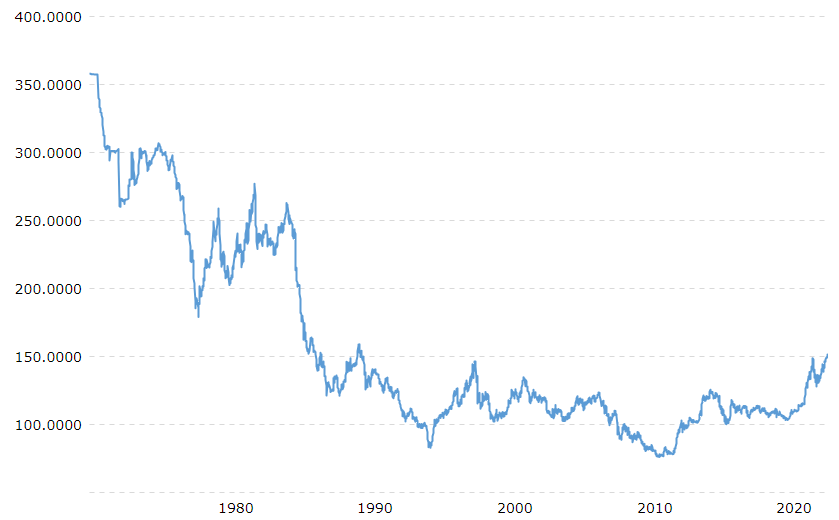
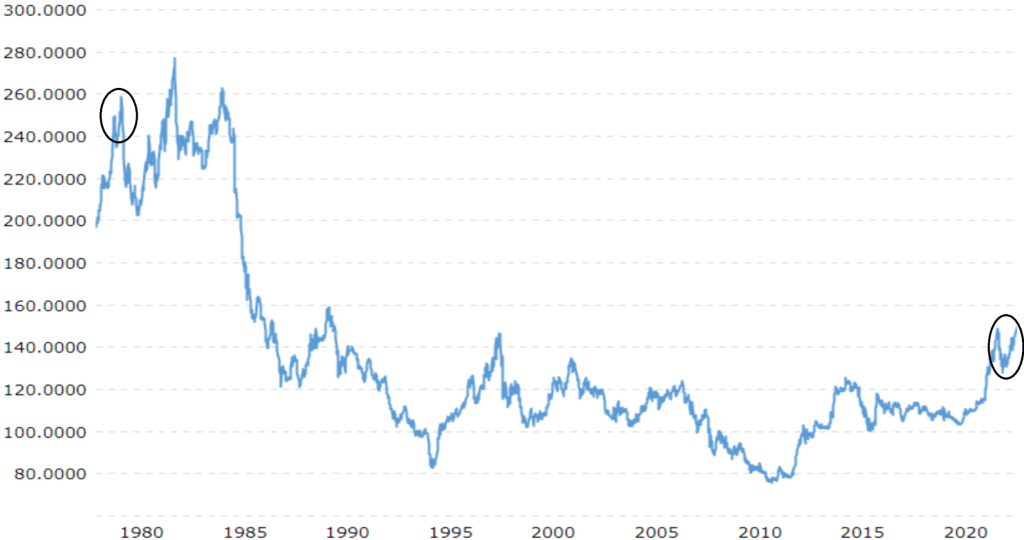
In the grand scheme of foreign exchange trading, seasoned traders often remind us of the significance of historical context. When examining the USDJPY pair, a panoramic view of its historic chart not only illustrates the ‘scale of things’ but also brings into perspective the monumental task of market intervention.
The USDJPY, a pairing of the United States dollar to the Japanese yen, serves as a pivotal indicator of two major economies’ strengths. The recent charts signal a moment of reflection for traders, potentially strategizing for short positions that could unfold over an extended period. This cautious approach is underscored by the fact that the Bank of Japan (BOJ) has not shown an immediate response to the currency movements, likening their potential interventions to “trying to fix a hole on a ship with putty.”
Why this reticence from the BOJ, you might ask? The historic lows and highs depicted in the charts suggest that any intervention could be futile if the market decides to run from here, given there’s ‘not much in the way’ to stop a trend once it gains momentum.
However, it’s crucial to understand that this analysis is not a call to action. Instead, it’s a meticulous attempt to juxtapose past market areas with the current landscape to aid in risk management and theory analysis. In the world of forex trading, where the winds of economic change can shift abruptly, such analytical insights are invaluable.
For traders, this evaluation serves as a compass rather than a map. It’s a tool to navigate the choppy waters of the USDJPY market, providing a framework within which one can manage risk more effectively. The historical perspective offers a lens to assess potential future movements, allowing traders to prepare rather than predict.
While the past can inform our strategies, the unpredictability of the forex market requires a balanced approach that incorporates both historical data and current market dynamics. As we chart our course in the USDJPY market, let this analysis be a guiding star – helping us manage risk with prudence, and trade with informed confidence.


 IBAFIN
Leave a comment