
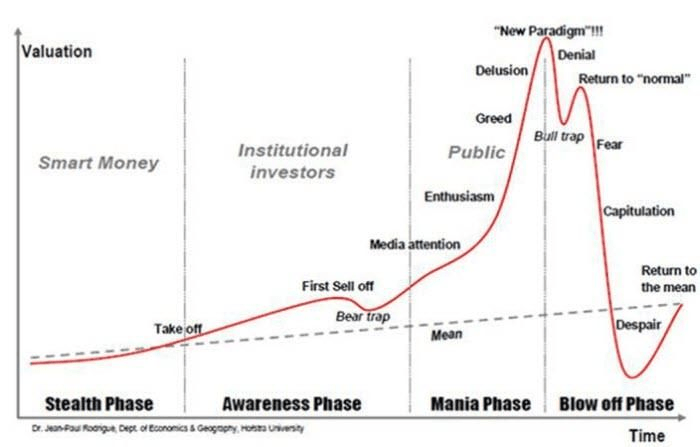
In the ever-tumultuous world of trading, where markets ebb and flow like the tide, it’s often not just the economic indicators or company reports that drive investor behavior, but also the underlying human emotions. A fascinating discussion on Bloomberg highlighted a curious trend among traders: the prevalent buying of call options not necessarily because they believe in the potential of the investment, but because of a deep-seated fear of missing out on possible gains. This behavior aligns closely with what’s known as the “Greed Phase” in the psychology of market cycles.
Let’s delve deeper into this phenomenon. The market cycle is typically broken down into various phases, each characterized by the dominant sentiment among investors. At the outset, there is the Stealth Phase, where the savvy “smart money” identifies an opportunity and invests, usually unnoticed by the larger public. This is followed by the Awareness Phase, where institutional investors start to catch on and the media begins to pay attention.
However, it is during the Mania Phase where things get particularly interesting – and risky. The early stages of this phase see increased media attention and public enthusiasm. As the trend continues, a bear trap may occur, causing a minor sell-off that is swiftly followed by even stronger gains. This leads us to the Greed Phase, where the discussion on Bloomberg is focused.
In this phase, the fear of missing out (FOMO) becomes a dominant force. Traders rush to buy calls – options that give the holder the right to purchase a stock at a set price within a certain timeframe – not because they’ve conducted thorough analysis or because they’re convinced of the inherent value, but because they’re driven by a herd mentality. They see prices soaring, they see others raking in profits, and they can’t bear the thought of being left behind. It’s no longer about sound investment strategies; it’s about the emotional need to be part of the action.
The result is a market that is hedging against FOMO. Traders aren’t just managing financial risks; they’re managing the risk of regret. But herein lies the danger: emotions, especially greed, can cloud judgment. What follows after the Greed Phase can often be a stark reality check – the market peaks and then enters the Blow-off Phase. This phase is characterized by denial, fear, and eventually despair, as the bubble bursts and valuations plummet back to, or below, their mean levels.
Understanding where we stand in the cycle is crucial for investors. If the analysis is correct and we are indeed in the Greed Phase, caution is advised. History has taught us that following the crowd can lead to perilous outcomes, and the real winners are often those who have the foresight to see beyond the mania. It’s a time for traders to re-evaluate their positions, to differentiate between genuine opportunity and speculative frenzy, and to remember that the fear of missing out should never outweigh the fundamentals of investing.
The Greed Phase serves as a reminder of the old adage: “Be fearful when others are greedy, and greedy when others are fearful.” As the cycle turns, the savvy investor is the one who can navigate these emotional currents, make rational decisions, and emerge with their portfolio not just intact, but perhaps even enhanced, when the cycle inevitably resets.


 IBAFIN
Leave a comment